 MAVERICK’S
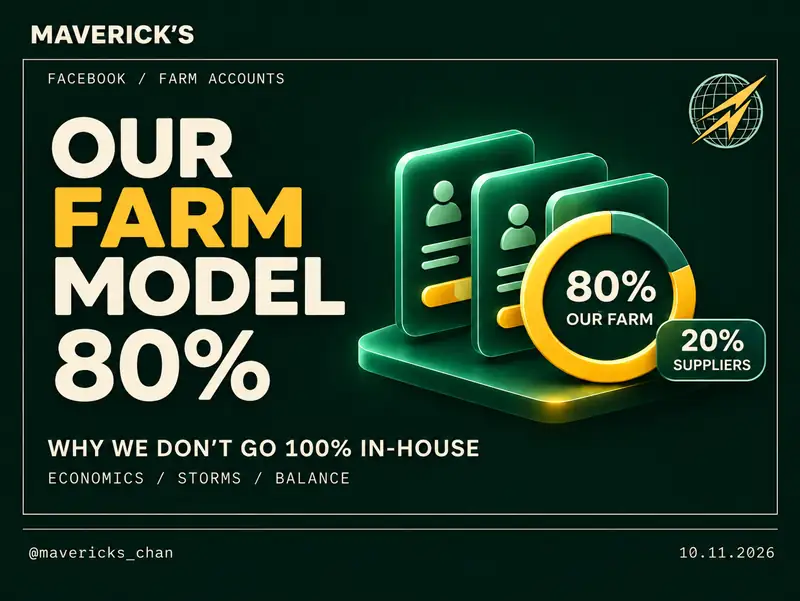
Our in-house account operation saves us tens of thousands of dollars a month. We deliver an account in 13 minutes on average, our infrastructure is 90% automated, and our dependence on suppliers is minimal. Yet we deliberately keep at least 20% of spend with them.
Here is why. The figures below come from our internal observations and calculations, not universal benchmarks for every team.
01 /The economics of in-house farming
AI has made it noticeably easier and cheaper to build and maintain our own account-farming operation.
Take $1,000,000 in monthly ad spend. Under our current funding setup:
- Supplier fees: 5% of top-ups ≈ 5.4% of ad spend.
- Fees on our cards: 2.5% of top-ups ≈ 2.7% of ad spend.
The difference is $27,000 per million dollars of spend. And that is just the fee difference.
02 /Unpaid bills
Unpaid bills are a separate factor that is often overlooked when comparing in-house accounts with agency accounts. According to our October figures, we had an average of $42,000 in unpaid bills per $1,000,000 of spend — 4.2% of ad spend.
Our average October billing ladder, based on a sample of 5,000 accounts:
- Spend $1,000–3,000 → bill $50.
- Spend $3,000–5,000 → bill $100.
- Spend $5,000–10,000 → bill $250.
- Spend $10,000–20,000 → bill $500.
- Spend $20,000–50,000 → bill $1,000.
Adding the fee difference and the amount of unpaid bills gives approximately $69,000 — 6.9% of $1 million in ad spend.
Calculation note: 4.2% and 6.9% are shares of ad spend, not a final ROI calculation. An unpaid bill does not, by itself, mean that the obligation has been settled. We therefore separate unpaid balances from confirmed fee savings and do not automatically treat them as profit.
03 /More than money
- 13 minutes — average account delivery time.
- No issuance caps — we scale the number of accounts to the task.
- Fast growth in billing thresholds — we reach volume sooner.
- Everything in one place — management through a System User Token.
- Whitelist options — available for the GEOs we work with.
- Fast reconciliation at the end of each week and month.
We adapt the infrastructure to our needs, not to a supplier’s capabilities. So why work with agencies at all?
04 /Why not 100%?
Ban waves. We have been burned more than once by putting all our eggs in one basket. Today, our own accounts work, billing thresholds rise and spend grows. Tomorrow, a wave of bans takes a significant share of those accounts offline.
That is why our rule is at least 20% of spend with trusted suppliers.
Consistent volume with suppliers gives us more than a reserve of accounts:
- Priority account delivery during a ban wave.
- Insights into working with accounts and GEOs.
- A live, direct point of contact.
- Additional capacity during widespread bans.
- Different account types: prepaid US/HK/VN, accounts with spending history, whitelist and BM2500.
When a ban wave hits, a reserve of in-house accounts is not enough. We need the ability to restore volume quickly using external infrastructure.
05 /Our balance
80% in-house farming / 20% suppliers.
This is not a hard ceiling or a formula for everyone. It is our current balance between economics and resilience.
We continue to develop, automate and reduce the cost of our in-house operation. But we will not abandon suppliers entirely.
What matters is not only how much we earn in calm conditions, but how quickly we restore volume when everything starts breaking down.